

Email: [email protected]Phone: 800.245.5676
Behind the Wins: Concept2 at Chip Ganassi Racing
Feb 16, 2026
Share

On race day at Chip Ganassi Racing, the results are clear and immediate. Lap times, pit stops, finishing position. What is less visible is the preparation behind it. In motorsport, small margins matter. That same focus carries into the gym.
For William Plummer, the Human Performance Trainer for Ganassi Racing, performance is part of the responsibility that comes with the role. Drivers and crew members rely on their preparation over a long season. The work needs to be consistent. It needs to transfer to race day.
His path to one of the top motorsports teams in the world did not start at a track. It started in a basement with a simple setup. A bench. A set of dumbbells. A middle school lacrosse player who wanted to be stronger and more competitive. The goal was straightforward. Get better. Put in the work. Keep improving.
“I fell in love with lacrosse pretty quickly,” William says. “But I also realized that if I wanted to be competitive, I had to change. I had to take ownership of my training.”
That ownership followed him to the University of Indianapolis, where he earned his degree in Exercise Science and played lacrosse for three years. Before college even started, he attended Army Basic Combat Training with the Reserves. It was there that he was introduced to CrossFit by a fellow soldier who pushed him to see conditioning differently.
“That experience ignited something,” William says. “Fitness stopped being just a career option. It became a passion.”
He earned his CrossFit Level 1 certification during college and began coaching everyday athletes. Then, during his senior year, an internship opportunity appeared with Chip Ganassi Racing. He did what most of us would do. He researched the team, saw they had just won the Indy 500, and realized the level of excellence he would be stepping into. He was selected for the internship. When it ended, he was offered the full-time role. In just three seasons, he has been part of an Indianapolis 500 victory, three consecutive championships, and more than 20 race wins.
Inside a high-performance organization like Ganassi, the demands on drivers and crew members are unique. Drivers must withstand sustained G forces, maintain focus for hours, and make split second decisions under extreme fatigue. Pit crew members require explosive power, strength, and resilience.
“If your cardiovascular system fails on lap 199 of 200 at the Indianapolis 500 and you cannot think clearly,” William says, “it does not matter how fast the car is. You are going to make a mistake.”
That is where Concept2 fits seamlessly into the program.
“The RowErg, SkiErg and BikeErg are staples for us,” William explains. “I like to call them the conditioning trinity. They allow me to chase a very specific stimulus, but each one challenges the body in a slightly different way.”
On any given day in the Ganassi performance space, you will see drivers and crew members rotating between the Concept2 RowErg, SkiErg, and BikeErg. The goal is not random sweat. It is targeted output.
“With Concept2, effort is measurable,” William says. “I can prescribe a pace. I can monitor consistency. I can adjust intensity in real time. That objectivity matters in a sport built on data.”
Warm-ups often begin on an Erg. Thirty seconds easy. Twenty seconds moderate. Ten seconds hard. The structure stays consistent, but the machine can change based on the athlete.
“If someone has an upper body limitation, we move to the BikeErg. If there is a lower body issue, the SkiErg becomes the solution. The stimulus stays the same. The path adjusts.”
That flexibility is essential in motorsports, where managing wear and tear is critical during a long season.
The RowErg, with its full body demand and powerful leg drive, is a favorite for building aerobic capacity that transfers to race day endurance. The SkiErg challenges shoulder stability and midline control, both essential for drivers managing steering loads and sustained upper body tension. The BikeErg allows athletes to push conditioning intensity while reducing joint impact and isolating lower body output when needed.
“As a trainer, I am always chasing a specific adaptation,” William says. “Concept2 gives me multiple ways to get there without compromising the athlete.”
The addition of the Concept2 StrengthErg took that philosophy even further.
“As soon as I saw the StrengthErg released, I told my boss we needed one,” he says. “I immediately saw the value.”
In a racing environment, there are times when traditional free weights are not the best option. During rehabilitation. In season when injury risk must be minimized. With newer athletes who need controlled strength development.
The StrengthErg provides measurable resistance with precise feedback through the monitor. William regularly programs bilateral and unilateral leg press variations for pit crew members who rely on powerful, symmetrical lower body output. He has also incorporated it into rehab protocols, including for a tire changer recovering from knee surgery.
“In racing, we obsess over improving performance in the car,” William explains. “On the human performance side, the StrengthErg allows us to measure force and output the same way we measure lap times. It fits our culture.”
That culture extends beyond the drivers and pit crew. William works with engineers, machine shop employees, and office staff throughout the organization.
“I strongly believe that fitness needs differ by degree, not by kind,” he says. “The same principles apply whether you are a driver or an accountant.”
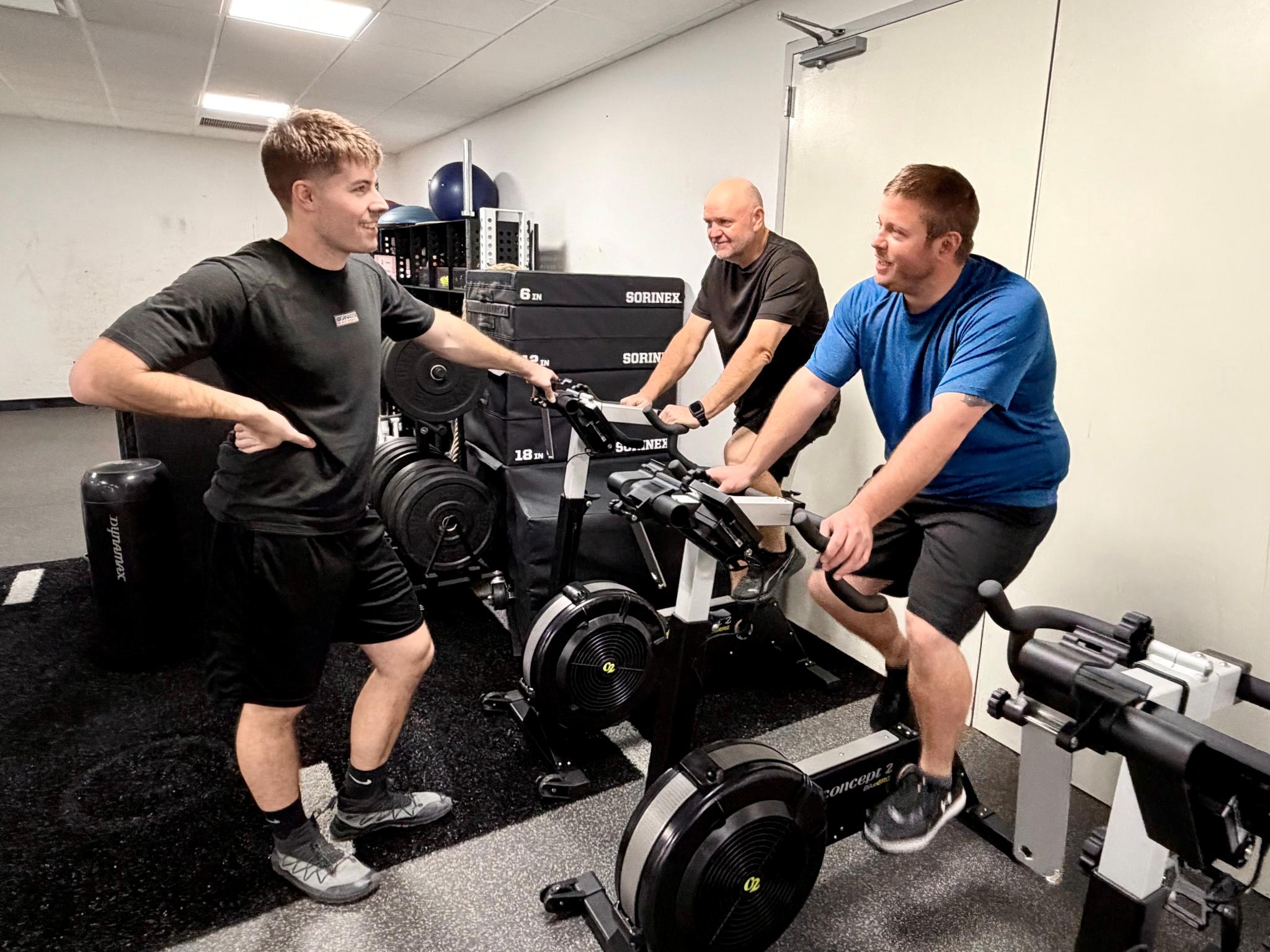
Concept2 Ergs support that inclusive approach. A seasoned pit crew member and a first-time gym user can both find a suitable challenge on a RowErg, SkiErg, or BikeErg. The monitor provides clear feedback. The effort is personal, but the standard is objective.
“It allows me to say, choose the Erg you want,” William says, “but here is the effort I expect. Giving people ownership while holding them to a standard, leads to better results.”
For those looking to bring a little Ganassi intensity into their own training, William shared a few of his go to Concept2 sessions.
One of his favorite interval workouts, which can be done on any Concept2 Cardio Erg or choice:
- 2 rounds: 2 min on / 2 min off
- 4 rounds: 1 min on / 1 min off
- 8 rounds: 30 sec on / 30 sec off
Another favorite is a 20 minute AMRAP:
- 5 calories on your least favorite Erg
- 10 calories on your middle favorite
- 15 calories on your favorite
When I’m on the road and there’s a RowErg in the hotel gym, I’ll often do:
- 10 x 500m row
- Rest 1 min between intervals
You can start that workout cold and still finish in under 30 minutes.
Another fun 20 min AMRAP:
- 20 calories on the RowErg
- 10 burpees over the RowErg
William’s approach is simple. Focus on what matters. Be consistent. Track the work. Adjust when needed.
At Concept2, we see training the same way. Clear goals. Honest effort. Reliable feedback from the RowErg, SkiErg, BikeErg, and StrengthErg. They are tools. The work is yours.
At Chip Ganassi Racing, race day shows the result. The foundation is built in the gym, one session at a time.
Most of us are not training for the Indianapolis 500. The process is still the same. Start. Do the work. Improve over time. That is performance.
Recent Posts
Get Updates and Training Tips from Concept2
Tags: