

Email: [email protected]Phone: 800.245.5676
/blog/concept2-erg-hyrox-tips-and-tricks
Concept2 Erg HYROX Tips and Tricks
Feb 24, 2026
Share
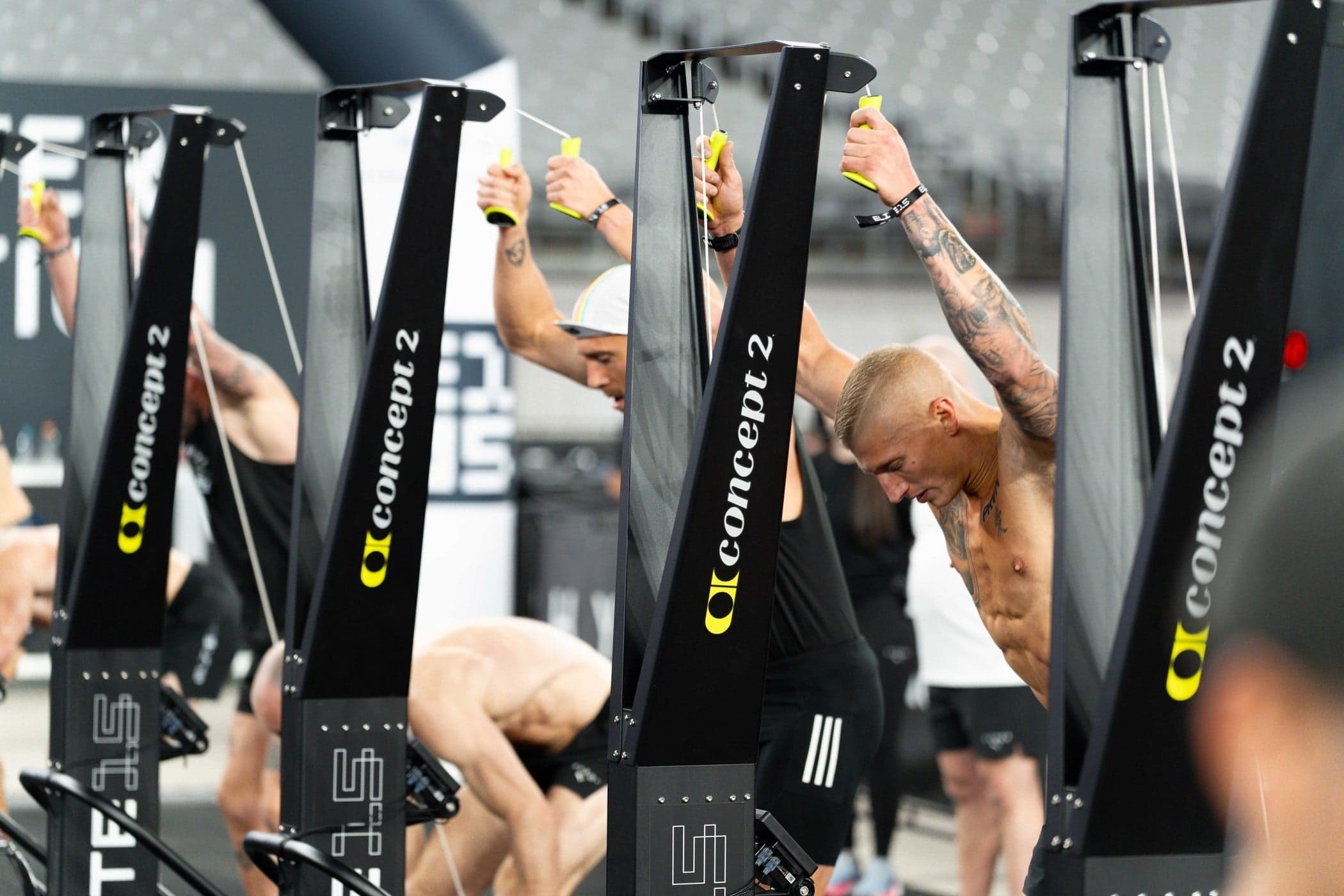
Theres a reason why those in the HYROX community have the saying “machines make monsters”. Concept2 Ergs are proven to build your aerobic engine, making it a key training tool for HYROX competitors looking for a low impact total body workout. The Concept2 SkiErg, RowErg, and BikeErg each offer unique advantages for building the power, endurance, and efficiency required on race day. With eight demanding stations and eight kilometers of running, smart pacing and technical execution can make or break your race. Understanding how to use these tools strategically in both training and competition can give hybrid athletes a meaningful edge.
Below learn directly from the experts at Concept2 headquarters in collaboration with 5x CrossFit Champion, and Chief Product Officer of Hard Work Pays Off (HWPO), Mat Fraser.
Concept2 SkiErg – Tips and Tricks for HYROX
The SkiErg is the first of eight stations in HYROX following the first kilometer run. It is key to be efficient with your technique and effort. Focus on using your bigger muscle groups; core, lats, and the weight of your body to pull the handles down, leading with your elbows bent. The flywheel will react to the effort you put in. If you lightly pull down, the pace will reflect the intensity. If you put more effort and power into each stroke, you will feel more resistance and you will have a faster pace. You can also adjust the flywheel once during your HYROX to have more or less air resistance – the closer you get to 10 on the damper setting, the more air resistance comes into play. We recommend a damper setting of 3-5, but be sure to experiment and see what works best for you as an athlete.
If you've spent time training on the SkiErg, aim to follow your 5K personal best pace. If you’re stepping on for your first or second time during your HYROX race, firstly, don’t worry, you aren’t the only one, and secondly, don’t go out too fast. Find an intensity that you feel very comfortable holding for 4-5 minutes. Aim for your stroke rate (SPM) to be in the 40-60spm range.
With 7 kilometers and 7 stations to go, easing into your race on the SkiErg will be better than trying to go all out on station 1. Outside of the race itself, the SkiErg is a powerful training tool, which gives a great low-impact full body workout. We recommend using the SkiErg to train for HYROX by practicing both short high intensity 1 minute intervals, as well as longer 20-30 minute pieces, will help you increase your power, and endurance receptively.
Mastering the RowErg for Hybrid Athletes
The Concept2 RowErg has been a trusted tool for professional and novice athletes alike for decades. With the same flywheel technology as the SkiErg from station 1, learning proper technique and stroke rate will greatly benefit the hybrid athlete. Also similar to the SkiErg, that 3-5 damper setting is likely going to benefit most athletes for efficiency for training and racing. Your most comfortable foot position will be with the straps around the ball of your foot. In this short race, getting in and out of the RowErg straps quickly will be useful.
It’s a common misconception that rowing is primarily an upper body workout, when in reality, your legs are the most powerful tool in the RowErg stroke. Simply, the work portion of the rowing stroke, or the drive, is legs, body, arms. The recovery of the stroke will be arms, body, legs, where you begin by pushing the handle forward, followed by the hips and finally legs. The simple cues of leg, body, arms will help with the basic sequence, though as Mat Fraser, 5x CrossFit Games champ says, the RowErg is all ‘legs, legs, legs.’
If you know your 5k RowErg pace, aim to apply this pace to the 1k RowErg in station 5. Your drive to recovery should be at a 1:2 ratio, if it takes you about a second to go the full length of the drive, aim for 2 seconds getting the handle back to your starting position. This is known as the catch portion of the rowing stroke. Timing your breathes on the recovery of your stroke is going to help when you’re just over halfway into the race. Aim to have your cadence to be between 24-32 strokes per minute (SPM).
The Concept2 RowErg has been a top training tool for athletes for decades. The rowing stroke is both low impact on the joints, and highly effective at achieving a full body workout. Working out 85% of the body’s muscles, rowing is great for building power and endurance for HYROX.
Concept2 BikeErg- The Secret HYROX Training Tool
Whether you’re trying to do long zone 2 workouts, supplement your long runs, or blast through HIIT intervals, the BikeErg is the hyrbid training tool you need. The BikeErg is a top training tool for many elite HYROX athletes. Just ask 2025 HYROX World Champion, Linda Meier. She says, “Concept2 Ergs play a very big role in my training, especially the BikeErg. From warm ups, cool downs, zone two training, and threshold work, I use the BikeErg for it all.”
The BikeErg is a versatile and compact training tool that you can use to elevate your aerobic engine for HYROX. You won’t see it on the competition floor, but it can be very beneficial to your training. The BikeErg is fairly straight forward to set up; aim to have a slight bend in your knees at the bottom of the pedal stroke when setting the seat height, and the handlebars should be set at a height where you feel comfortable. Many use the BikeErg to supplement for running to avoid pounding on the body. Aim for 80-90 RPM to replicate a running cadence of 160-180 strides per minute, encouraging efficient running economy come race day.
The BikeErg is a powerful staple for any home training space or HYROX Training Center. Reap the benefits of an efficient aerobic workout, without the impact of running, allowing you to show up ready to take on the hard days when it counts most.
Mastering the Concept2 SkiErg, RowErg, and BikeErg equips HYROX athletes with the strength, endurance, and control needed to perform at a high level across all eight stations. From refining technique and pacing on race day to building aerobic capacity and resilience in training, each erg plays a distinct role in long-term development. When used intentionally, these tools help athletes balance intensity with efficiency—an essential skill in a race that rewards smart execution. Train with purpose, race with confidence, and let every stroke and pedal bring you closer to your best performance.
Recent Posts
Tags: